
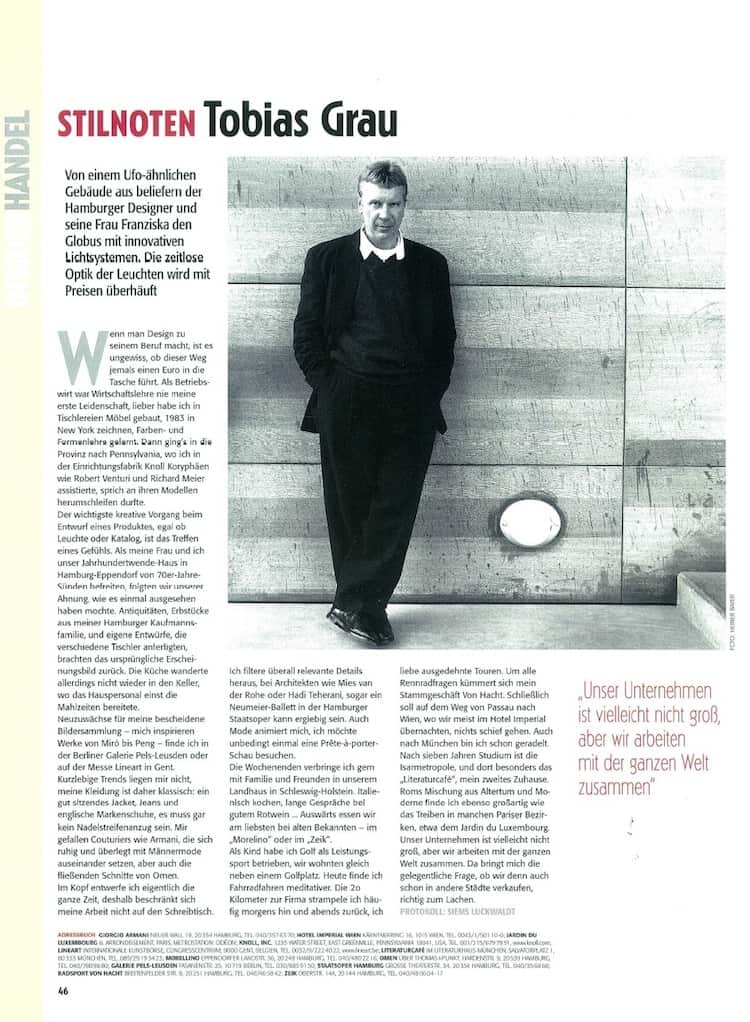
„Von einem Ufo-ähnlichen Gebäude aus beliefern der Hamburger Designer und seine Frau Franziska den Globus mit innovativen Lichtsystemen. Die zeitlose Optik der Leuchten wird mit Preisen überhäuft“
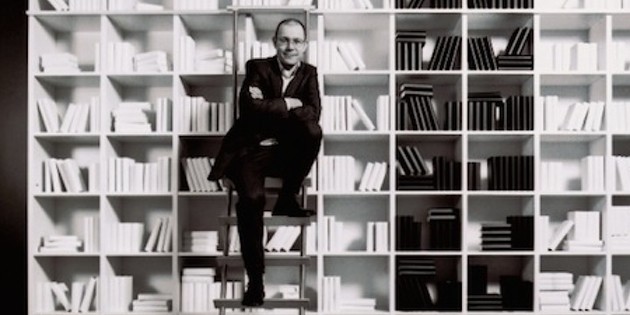
„Von einem Ufo-ähnlichen Gebäude aus beliefern der Hamburger Designer und seine Frau Franziska den Globus mit innovativen Lichtsystemen. Die zeitlose Optik der Leuchten wird mit Preisen überhäuft“
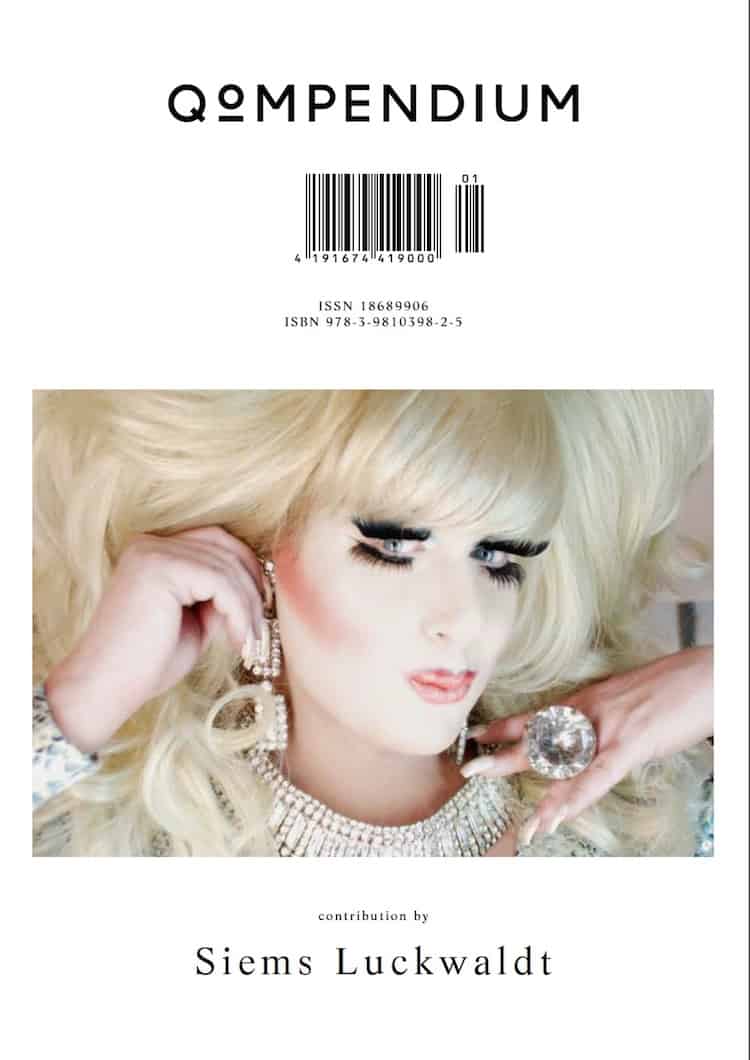
„Basically, I’m giving them a clown and DJ for the price of one, says Lady Bunny who also co-founded and, for over 20 years, hosted the legendary drag festival Wigstock“
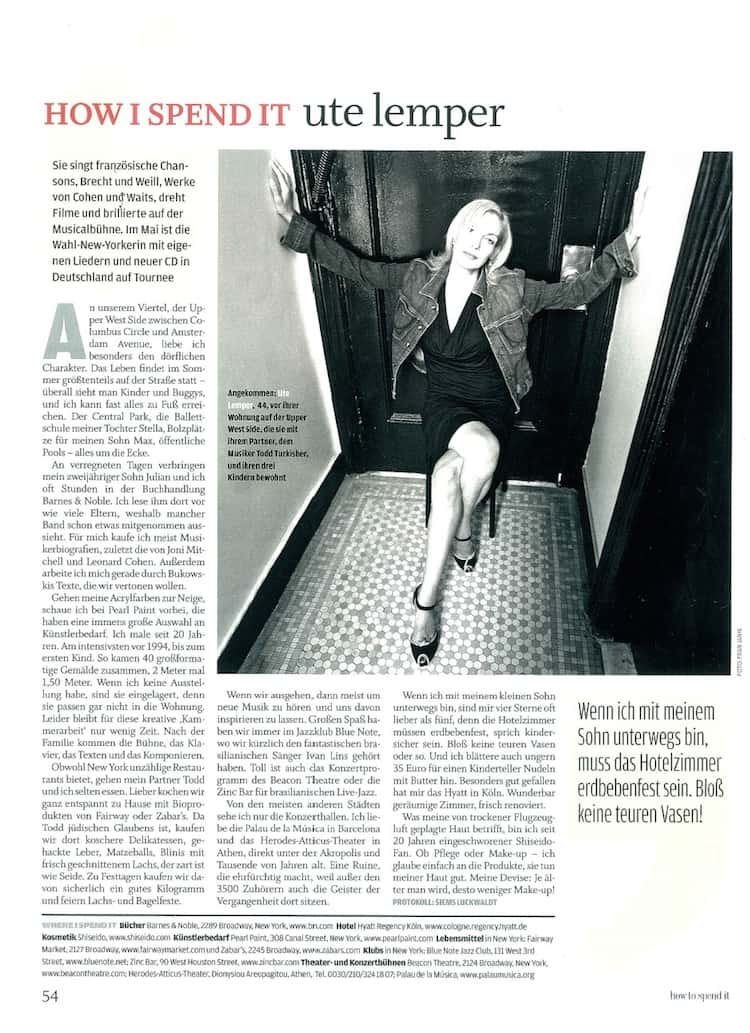
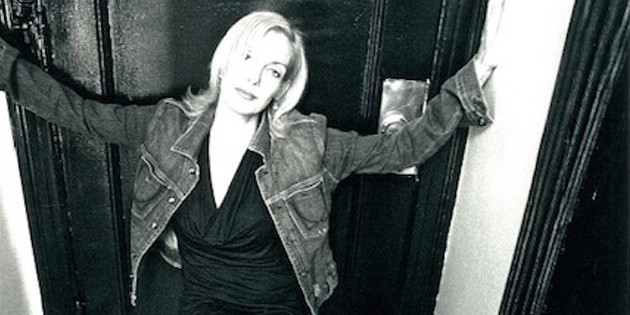
„Sie singt französische Chansons, Brecht und Weill, Werke von Cohen und Waits, dreht Filme und brilliert auf der Musicalbühne. Im Mai ist die Wahl-New-Yorkerin mit eigenen Liedern und neuer CD in Deutschland auf Tournee“
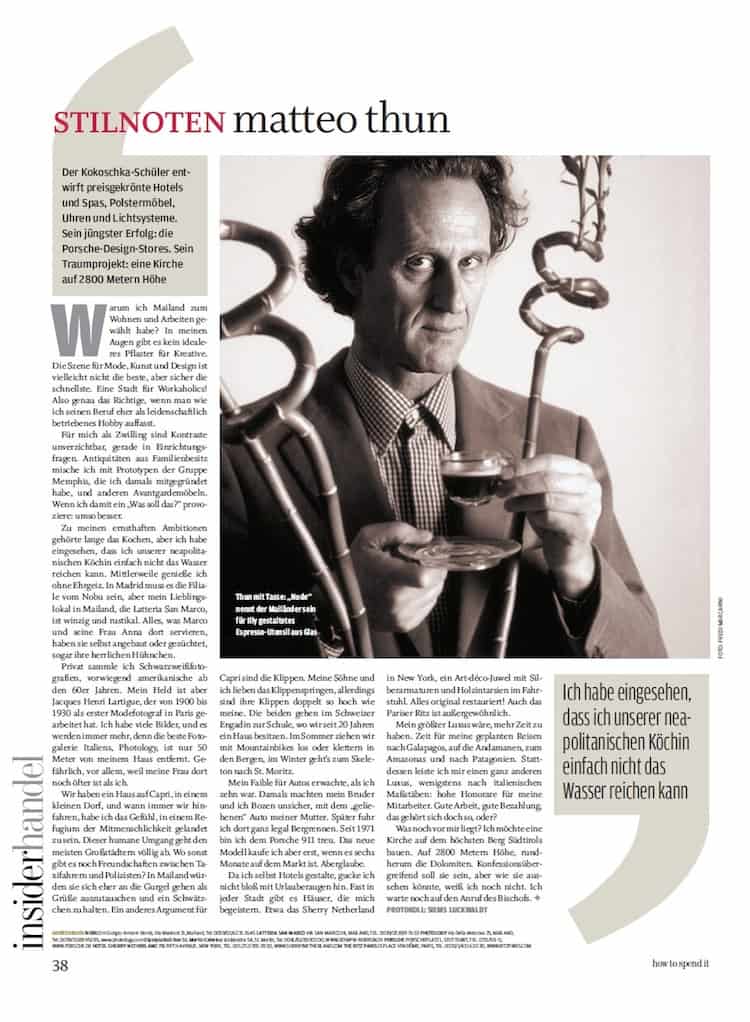
„Der Kokoschka-Schüler entwirft preisgekrönte Hotels und Spas, Polstermöbel, Uhren und Lichtsysteme. Sein jüngster Erfolg: die Porsche-Design-Stores. Matte Thuns Traumprojekt: eine Kirche auf 2800 Metern Höhe“
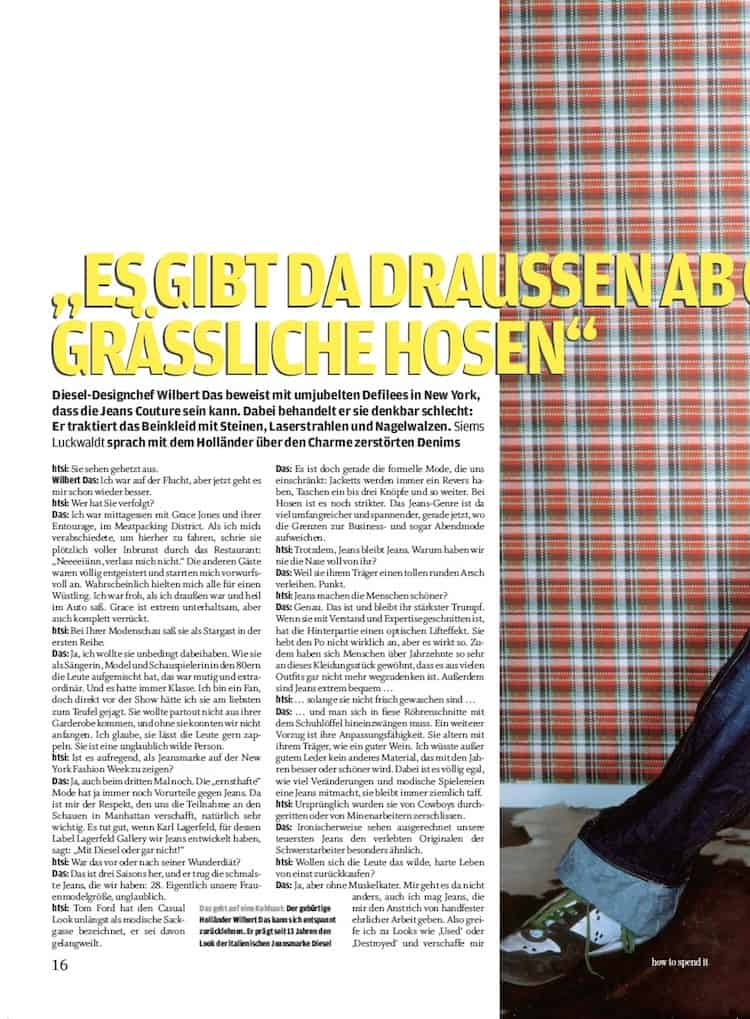
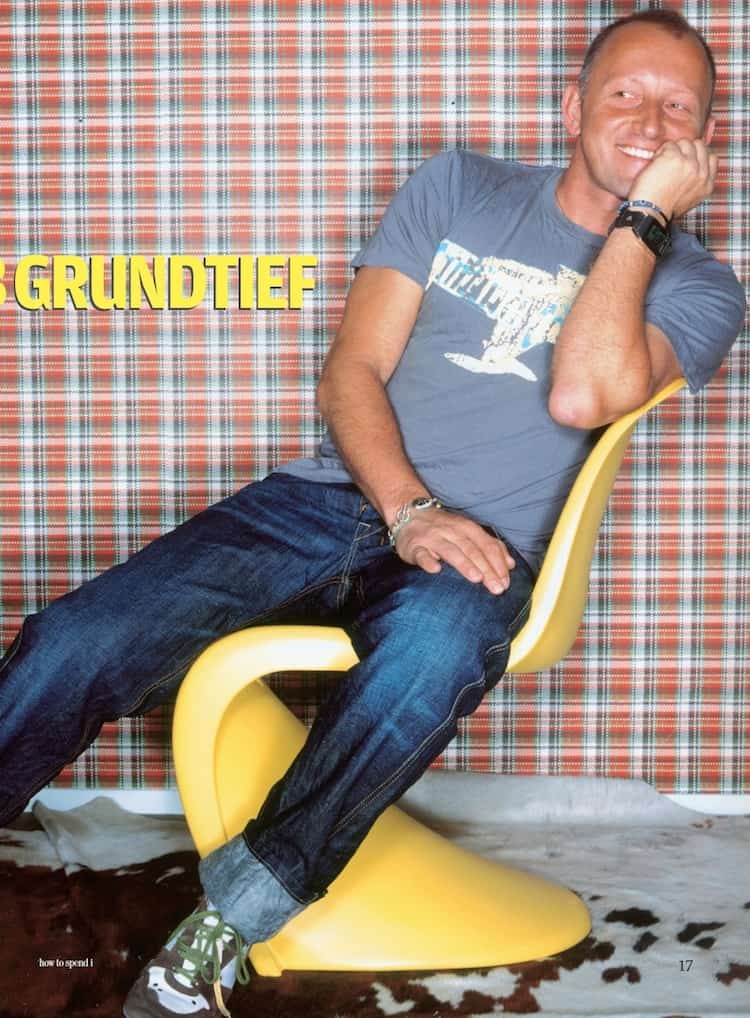
„Diesel-Designchef Wilbert Das beweist mit umjubelten Defilees in New York, dass die Jeans Couture sein kann. Dabei behandelt er sie denkbar schelcht: Er traktiert das Beinkleid mit Steinen, Laserstrahlen und Nagelwalzen. Siems Luckwaldt sprach mit dem Holländer über den Charme zerstörten Denims.“
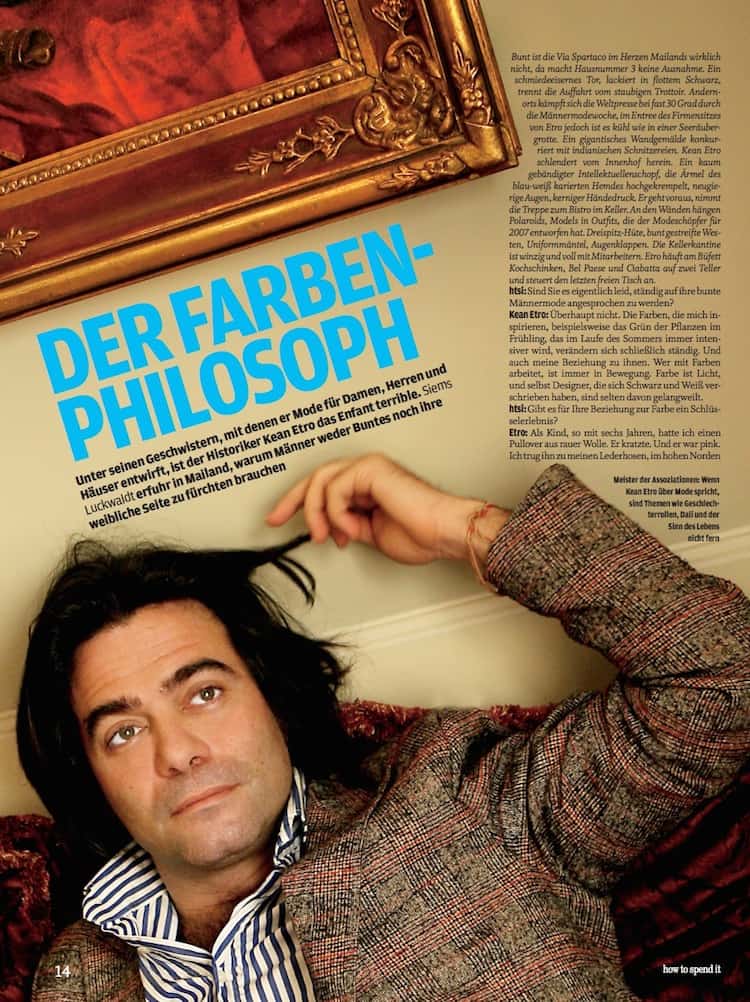
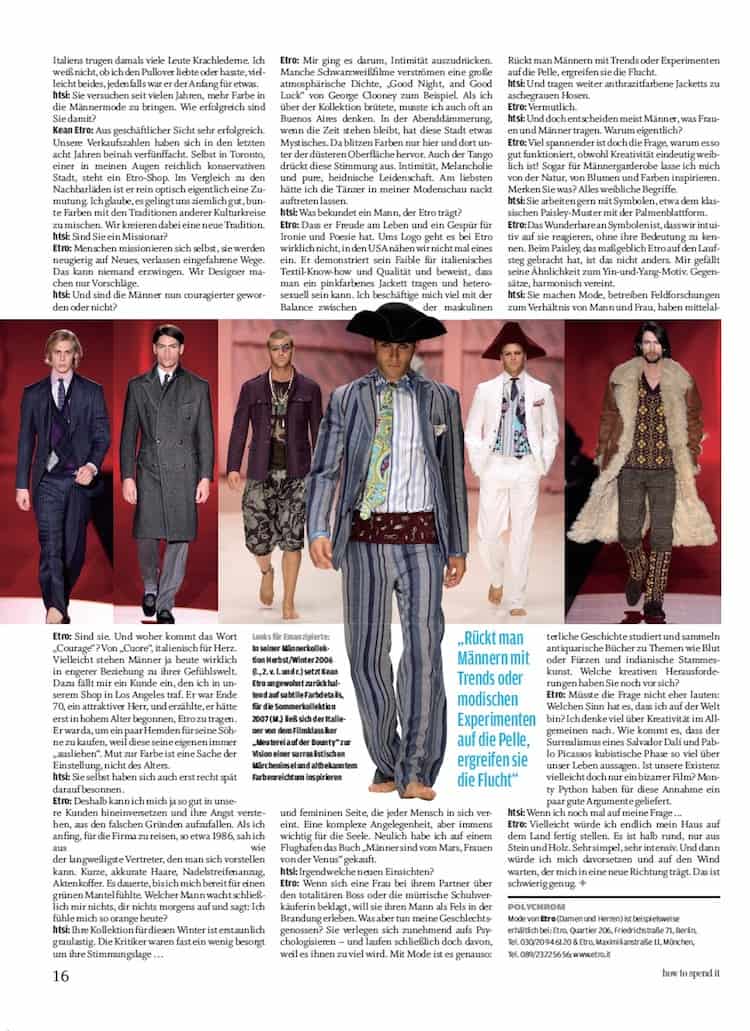
„Der Farben-Philosoph. Unter seinen Geschwistern, mit denen er Mode für Damen, Herren und Häuser entwirft, ist der Historiker Kean Etro das Enfant terrible. Siems Luckwaldt erfuhr in Mailand, warum Männer weder Buntes noch ihre weibliche Seite zu fürchten brauchen“

HÖRTIPP:
Lernen Sie Designer, Fotografen, Künstler und Kreative in spannenden Podcast-Interviews kennen: Nahtlos! Das Lifestyle Podcast
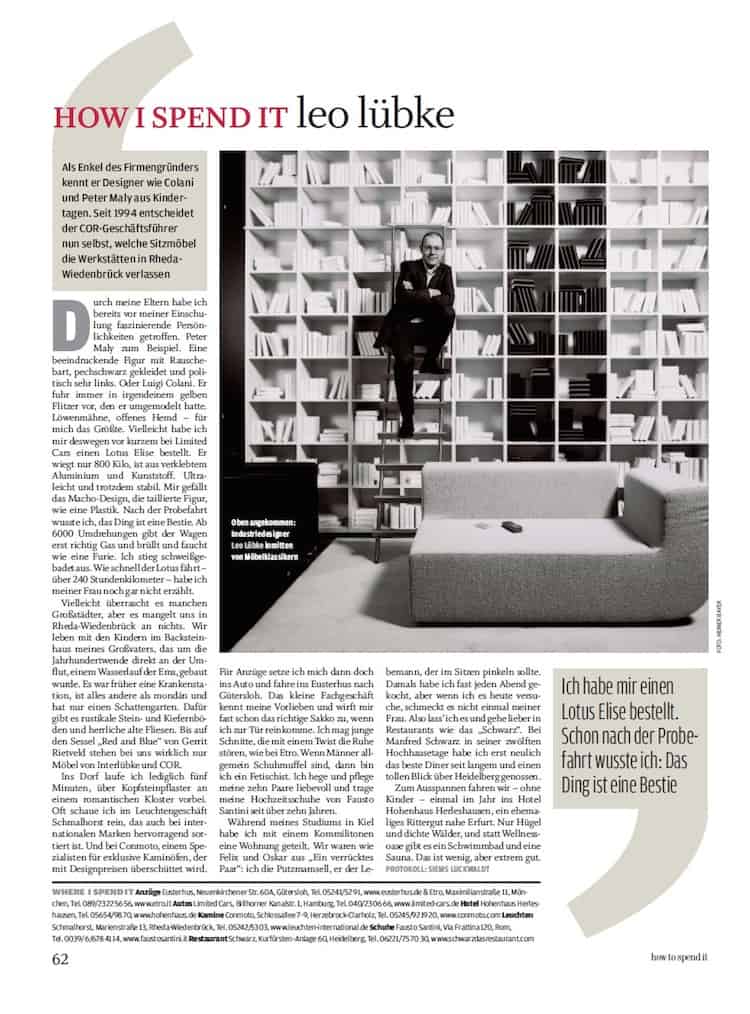
„Als Enkel des Firmengründers kennt Leo Lübke Designer wie Colani und Peter Maly aus Kindertagen. Seit 1994 entscheidet der COR-Geschäftsführer nun selbst, welche Sitzmöbel die Werkstätten in Rheda-Wiedenbrück verlassen“
Foto: Heiner Bayer
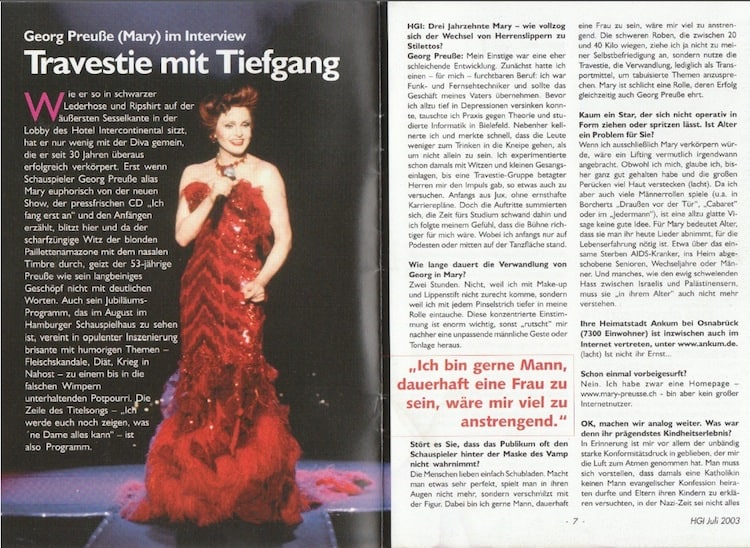
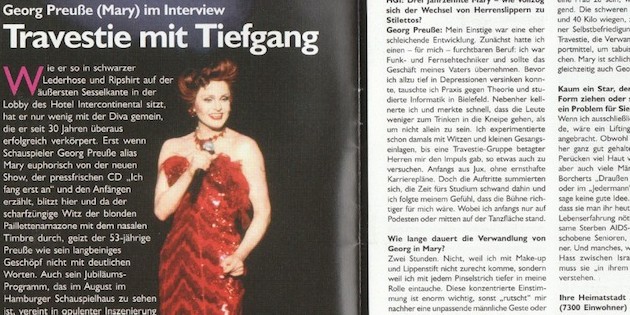
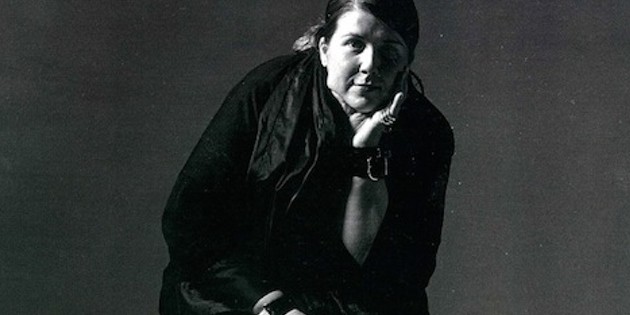
„Travestie mit Tiefgang. Wie er so in schwarzer Lederhose und Ripshirt auf der äußersten Sesselkate in der Lobby des Hotel Intercontinental sitzt, hat Georg Preuße wenig gemein mit der Diva, die er seit über 30 Jahren überaus erfolgreich verkörpert […]“
HÖRTIPP:
Lernen Sie Designer, Fotografen, Künstler und Kreative in spannenden Podcast-Interviews kennen: Nahtlos! Das Lifestyle Podcast
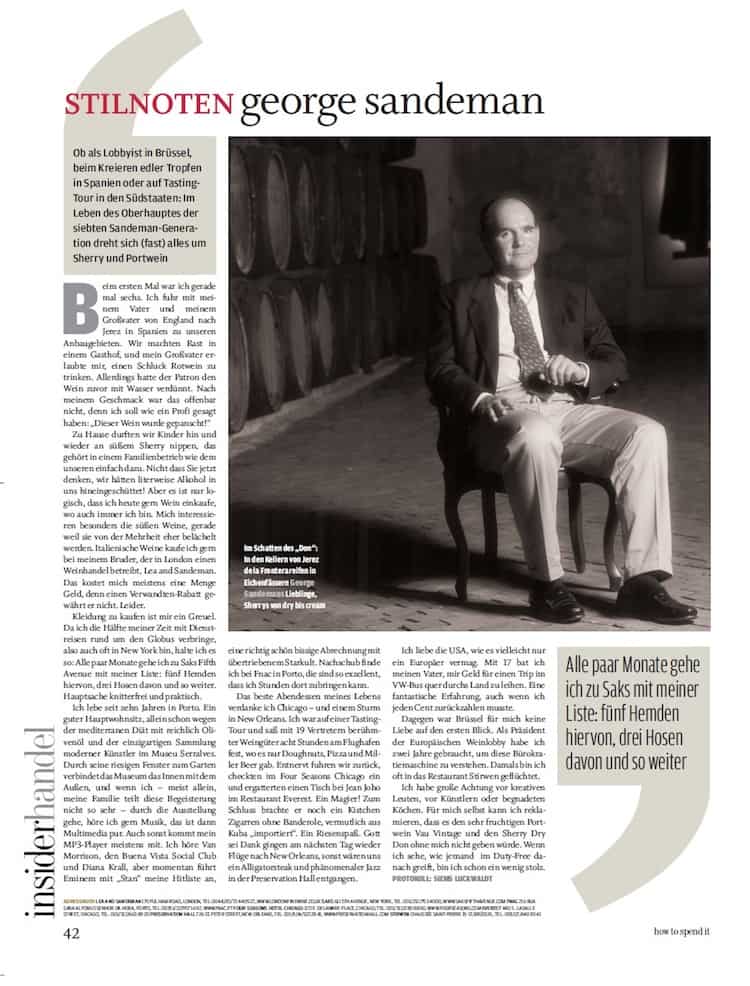
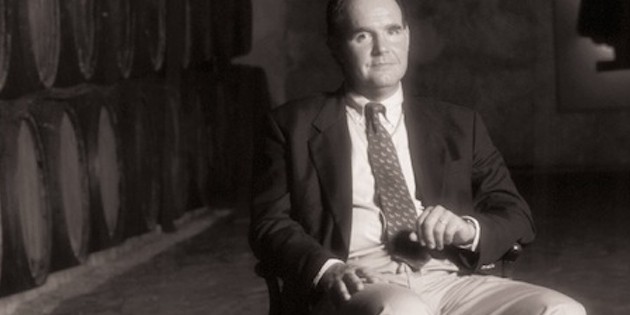
„Ob als Lobbyist in Brüssel, mein Kreieren edler Tropfen in Spanien oder auf Tasting-Tour in den Südstaaten der USA: Im Leben des Oberhauptes der siebten Sandeman-Generation dreht sich (fast) alles um Sherry und Portwein“
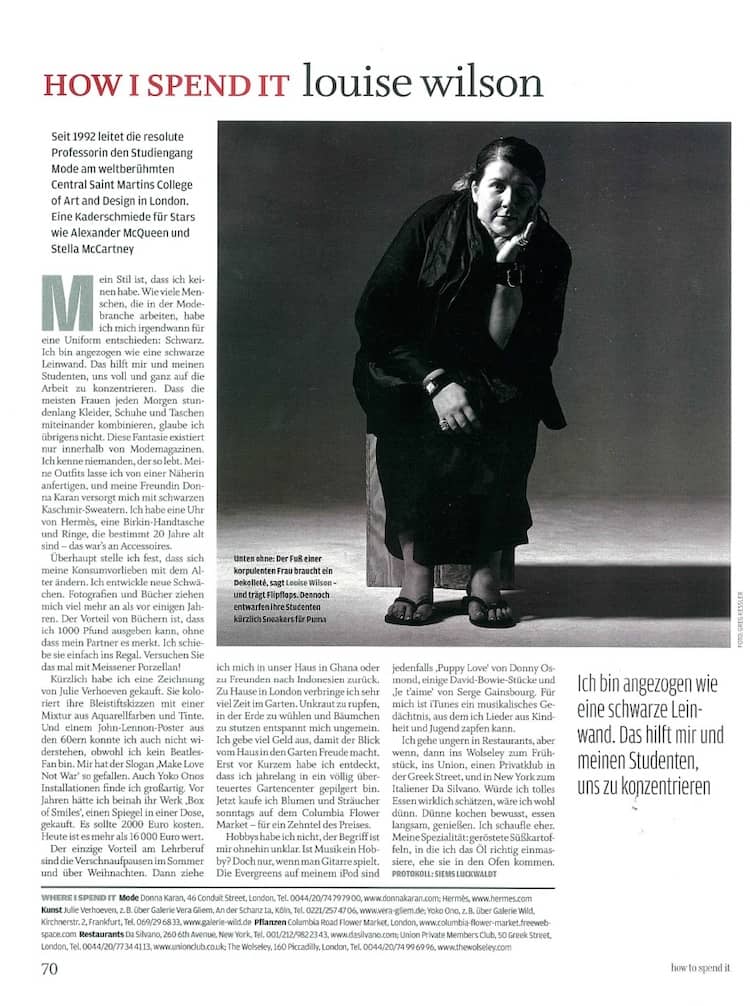
„Seit 1992 leitet die resolute Professorin den Studiengang Mode am weltberühmten Central Saint Martins College of Art and Design in London. Eine Kaderschmiede für Stars wie Alexander McQueen und Stella McCartney“
Foto: Greg Kessler
HÖRTIPP:
Lernen Sie Designer, Fotografen, Künstler und Kreative in spannenden Podcast-Interviews kennen: Nahtlos! Das Lifestyle Podcast
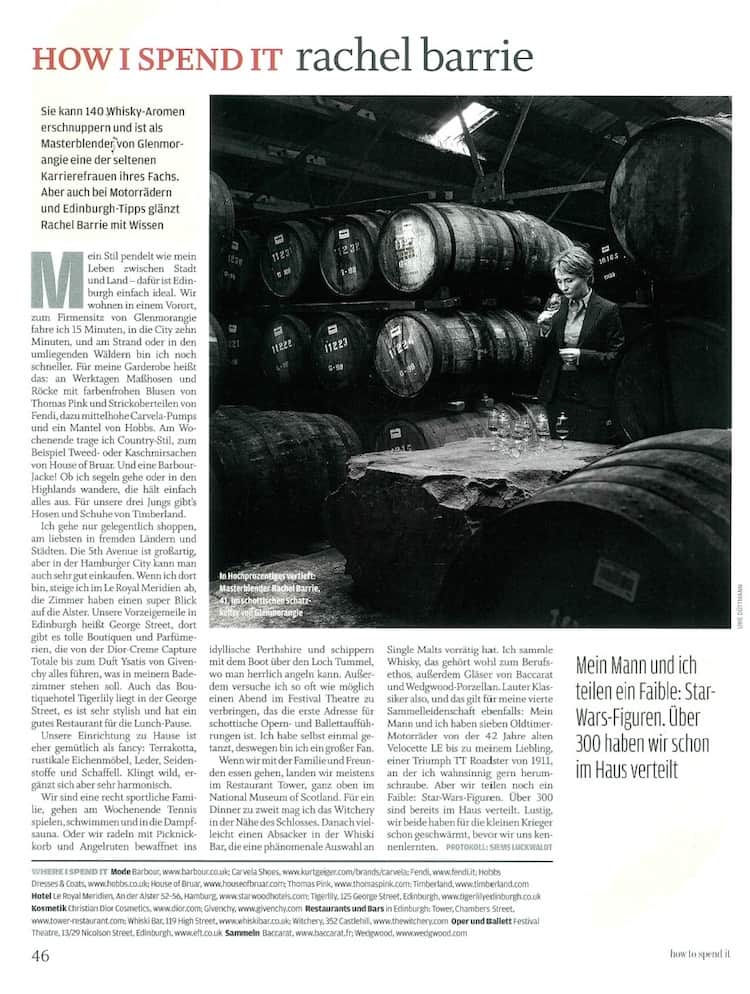
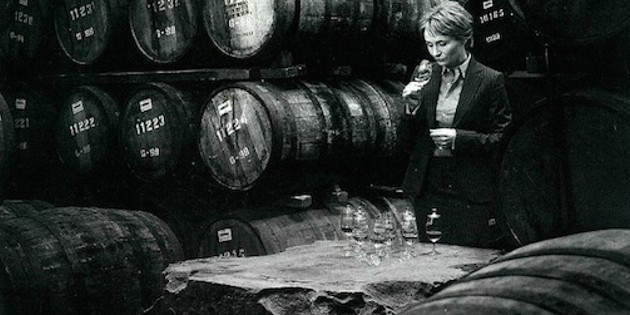
„Sie kann 140 Whisky-Aromen erschnuppern und ist als Masterblender von Glenmorangie eine der seltenen Karrierefrauen ihres Fachs. Aber auch bei Motorrädern und Edinburgh-Tipps glänzt Rachel Barrie mit Wissen“
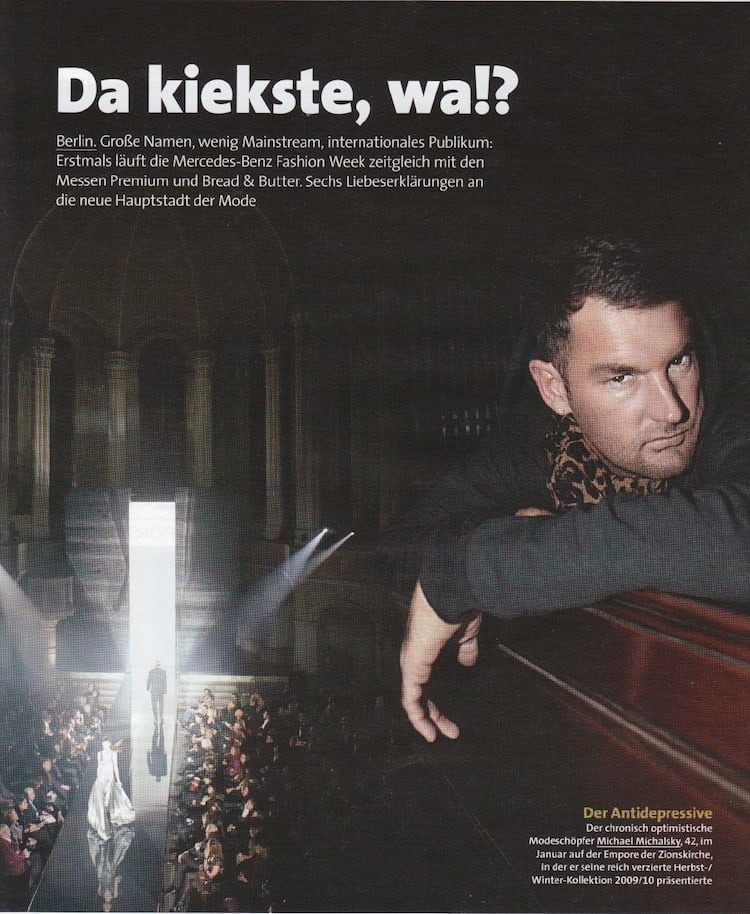
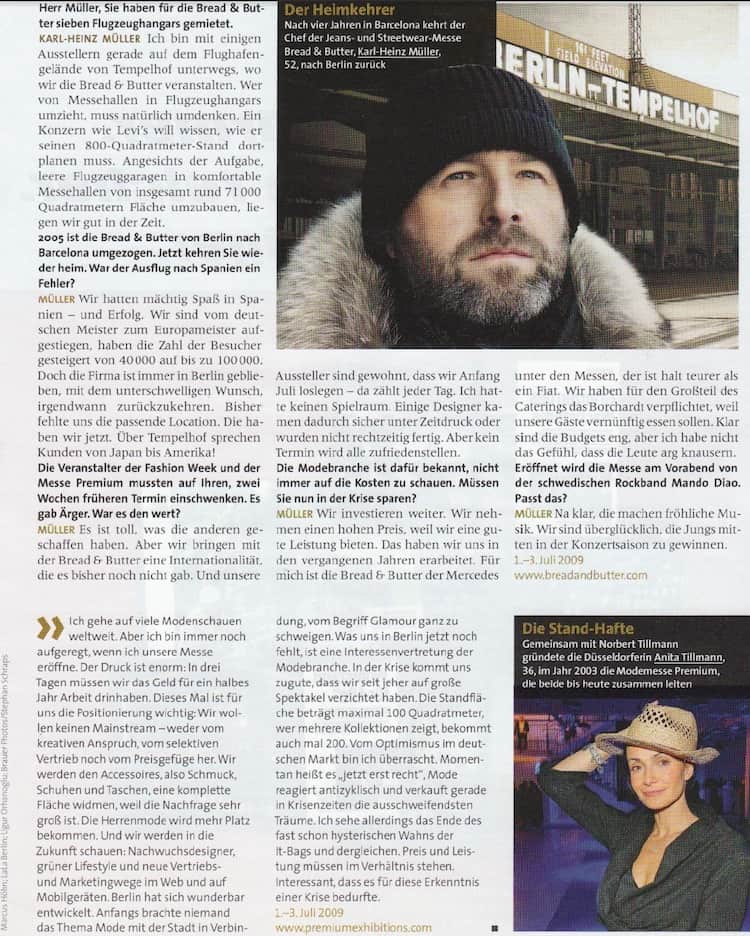
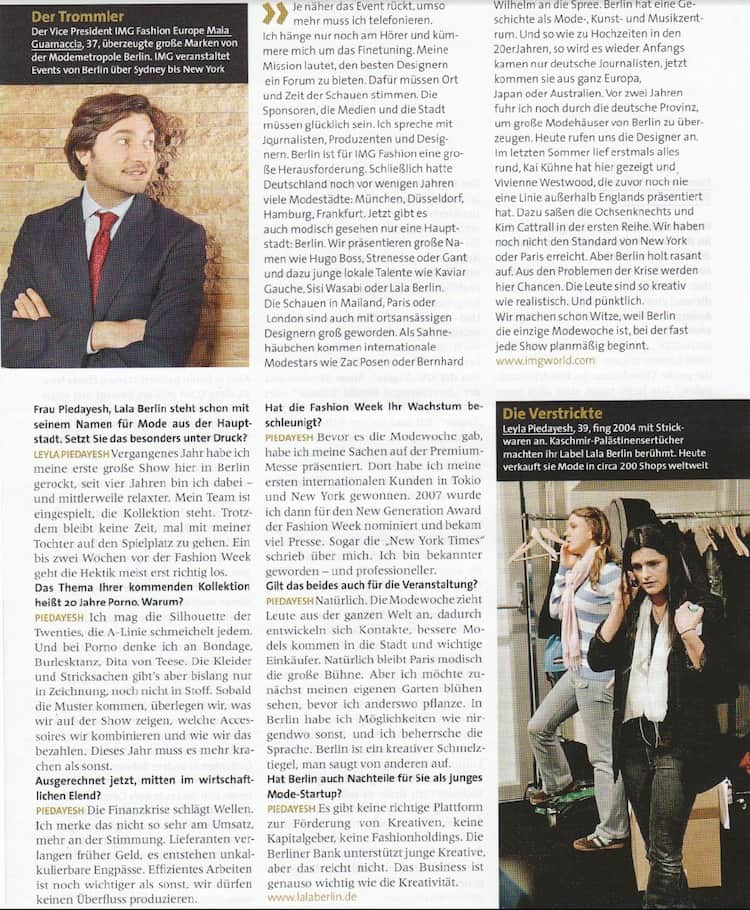
„Große Namen, wenig Mainstream, internationales Publikum: Erstmals läuft die Mercedes-Benz Fashion Week zeitgleich mit den Messen Premium und Bread & Butter. Sechs Liebeserklärungen an die neue Hauptstadt der Mode“
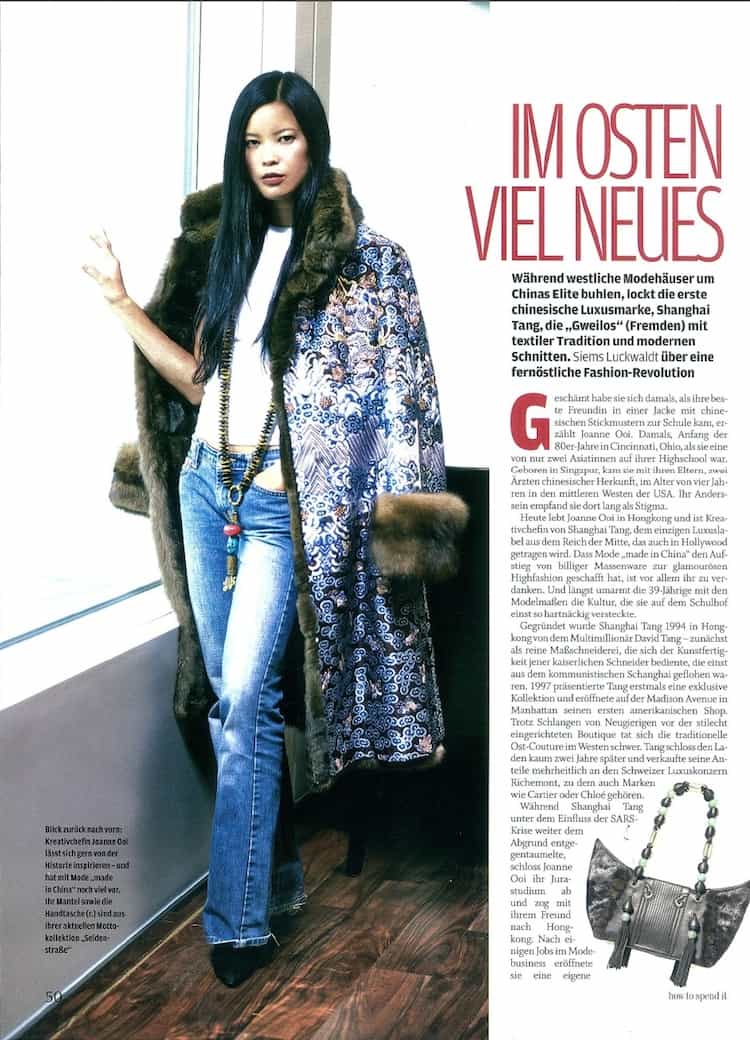
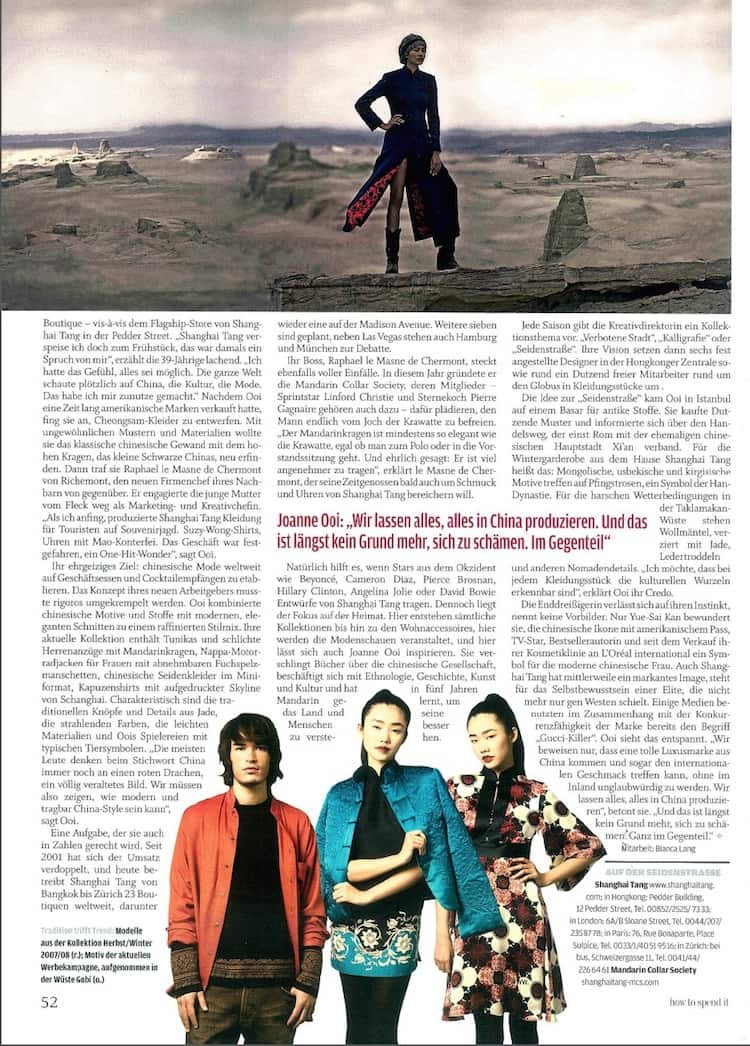
„Im Osten viel Neues: Während westliche Modehäuser um Chinas Elite buhlen, lockt die erste chinesische Luxusmarke, Shanghai Tang, die ‚Gweilos‘ (Fremden) mit textiler Tradition und modernen Schnitten. Siems Luckwaldt sprach mit Kreativchefin Joanne Ooi über eine fernöstliche Fashion-Revolution“
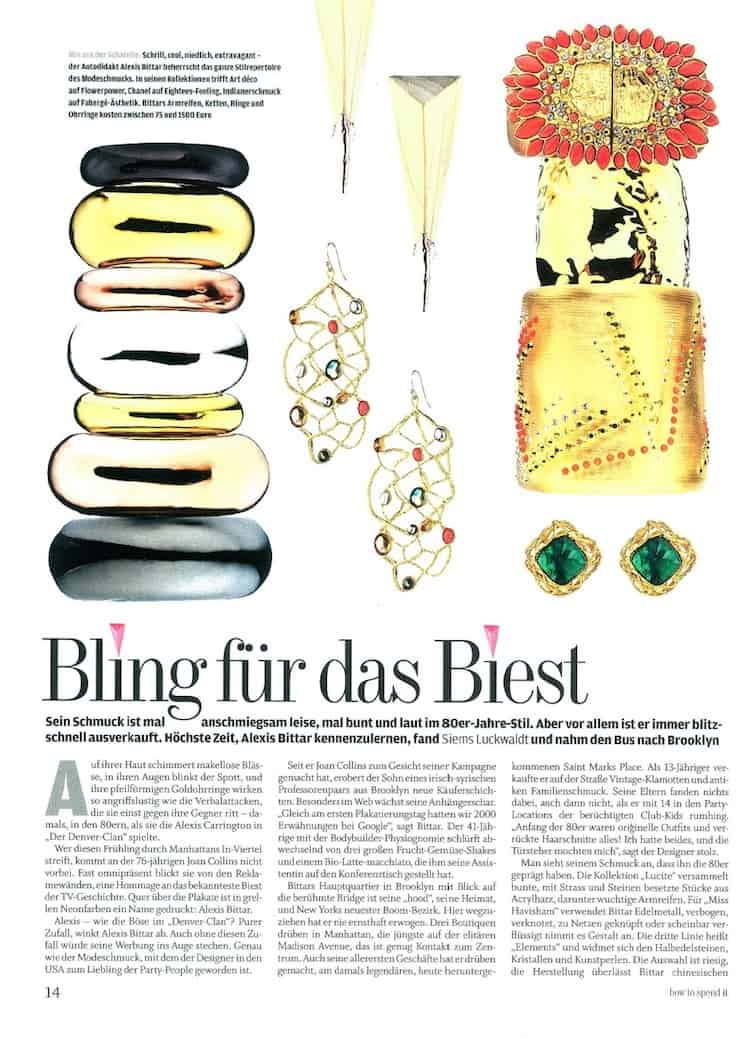
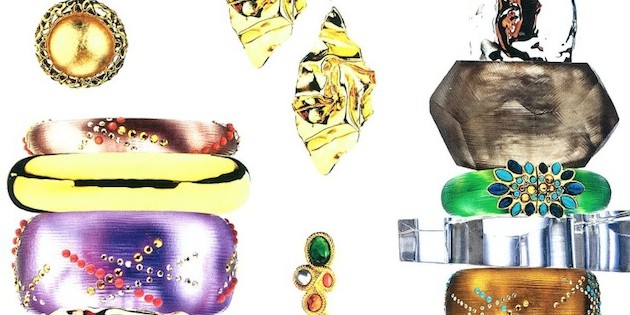
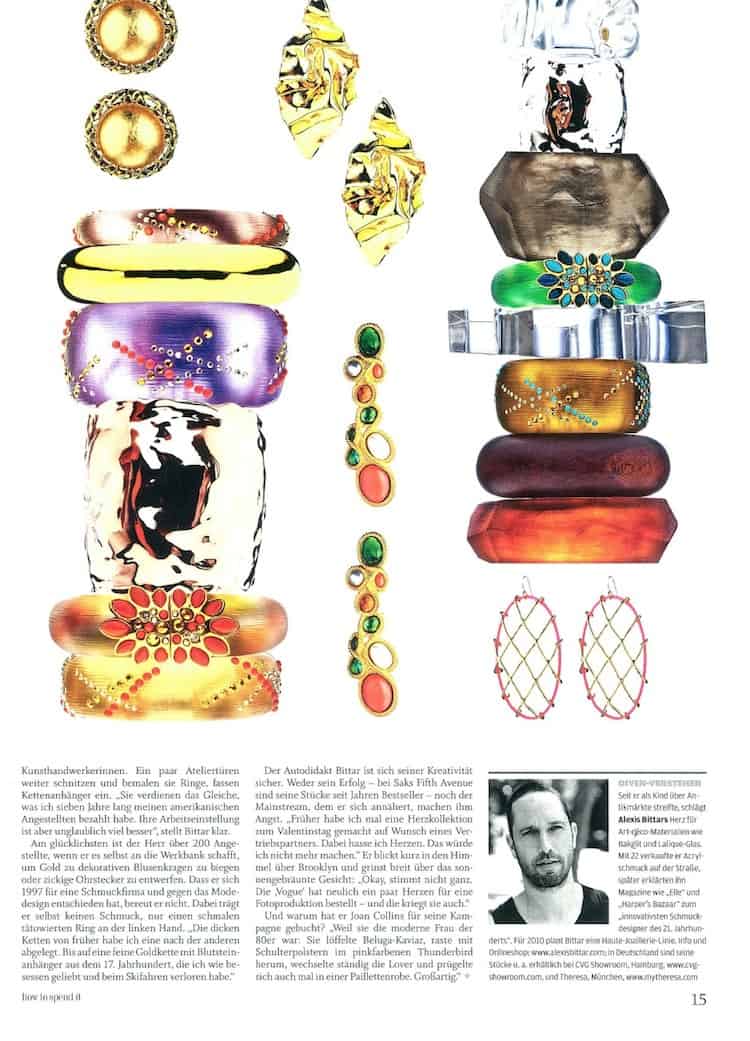
„Bling für das Biest. Sein Schmuck ist mal anschmiegsam leise, mal bunt und laut im 80er-Jahre-Stil. Aber vor allem ist er immer schnell ausverkauft. Höchste Zeit, Alexis Bittar kennenzulernen, fand Siems Luckwaldt und nahm den Bus nach Brooklyn“
HÖRTIPP:
Lernen Sie Designer, Fotografen, Künstler und Kreative in spannenden Podcast-Interviews kennen: Nahtlos! Das Lifestyle Podcast
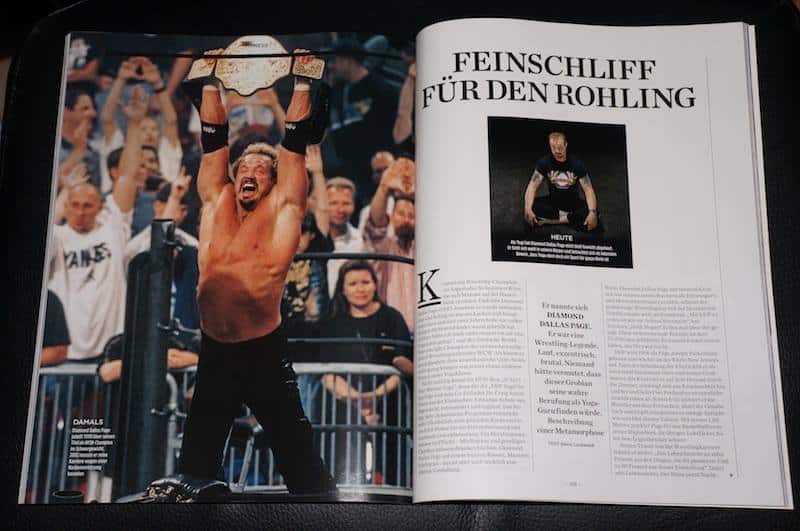
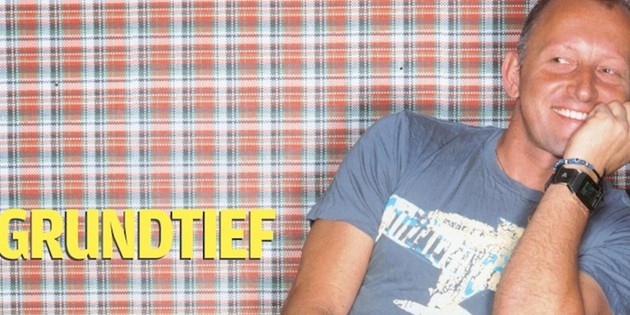
„Er nannte sich Diamond Dallas Page. Er war eine Wrestling-Legende. Laut, exzentrisch, brutal. Niemand hätte vermutet, dass dieser Grobian seine wahre Berufung als Yoga-Guru finden würde. Beschreibung einer Metamorphose“

From stacking shelves at Habitat in his teens to running Studio Conran, Sebastian’s life has been focused on understanding how things are made, sold, and used, as well as designing innovative, stylish & satisfying products. He has seen many thousands of successful & enduring products through from concept to consumer. Whether for John Lewis or Virgin Atlantic, Nigella or Nissan, to the many other industry leading clients across the globe that he has worked with during his career.
After leaving Bryanston school with A levels in Maths, Physics & Chemistry, Sebastian studied Industrial Design Engineering at Central St. Martins; where as Union treasurer he gave the Sex Pistols their first booking, and designed the record sleeves, posters, and clothing for The Clash.
1978: joined corporate identity consultancy Wolff Olins, taking creative responsibility for key accounts such as Shell and Pilkington.
1981: led hard-merchandise design at Mothercare – a role that transformed the appearance and performance of childcare equipment.
1986: started product design studio, Sebastian Conran Associates.
1991: formed furniture design & manufacturing studio/workshops with Tom Dixon
1999: SCA merged with the Conran group where Sebastian was responsible for all product and branding design.
2009: Sebastian Conran Associates is re-established in purpose built studio workshops in Kensington
He has taught furniture design at the Royal College of Art; lectures frequently; judges many international design awards [Audi, D&AD, Design Week, Dyson, Red Dot, RSA, etc.]; and has written several books, articles and papers on design.
An active member of many bodies, he has also worked with many design & educational institutions including:
Designer in Residence, Sheffield University Science Faculty
Visiting Professor of the University of the Arts London
Chairman TSB’s Design SIG transforming science into culture
Chairman of Design & Technology Alliance – UK Home Office’s body tackling crime with design
Chairman of the Creative Industries KTN steering group Technologies Innovation Network
Chairman Design Action in Scotland steering group Scotland’s Design & Industry knowledge exchange
Trustee of the Design Council – the UK’s national strategic body for design
Trustee of the Design Museum, and the Conran Foundation its founding body
Governor and Trustee of Bryanston School
Trustee of D&AD, the international body of creative professionals
Hon. Fellow, the Royal College of Art
Hon. Doctorate of Technology, Loughborough University
Hon. Doctorate of Arts, Hertfordshire University
Fellow of the Royal Society of Arts
Fellow of the Chartered Society of Designers
Fellow of the Institute of Packaging
Ambassador for ICAN, the children’s education charity
Ambassador for ACID, the anti copying in design lobby group
Awards
Universal Expert ‚Share + Serve‘ collection
Red Dot design award
Universal Expert ‚Prep + Cook‘ collection
Red Dot design award
Universal Expert ‚Counter + Sink‘ collection
Red Dot design award
Leonardo icon range
Red Dot design award
Tchibo kitchen
IF product design award
Sainsburys bY range
D&AD product design selection
Elle Deco most iconic products of the year
Nigella Lawson’s Living Kitchen
Homes & Garden’s Judges Award
Villeroy & Boch Aveo bathroom
IF product design awards
Smart Cafe Cafetiere
Design Council Millennium product
Smart Cafe OneCup
Red Dot product design award
Equilibrium scales
Excellence in Housewares award
FX design award
Micromap
British invention of the Year
Design Council Millennium product
John Lewis Radius Table
Furniture Guild Design Mark
John Lewis Boxer Shelves
Furniture Guild Design Mark
John Lewis Aerofoil Desk
Furniture Guild Design Mark
Anywayupcup
DBA Design effectiveness award, best of year
BFP most innovative use of plastic Horner’s Award
Design Council Millennium product
Sealine, T60 Aura Yacht Interior
Red Dot Award
Cannes Boat Show, Best in Category
Garmin, Motorboat of the Year
Yamagiwa Stem Ray light
Red Dot Award
Mothercare Via Pushchair
BFP most innovative use of plastic Horner’s Award
Yotel, Compact Hotels
International Forum, Product Design Award
Red Dot Award.
Siems Luckwaldt: Now, the names _____ (0:07), Westwood, Macqueen, Foster, even in this department store, top shelf. What gets us so crazy about British brands even just British sounding brands? What’s the secret?
Sebastian Conran:I think often it’s a sort of playful, pragmatism, but I think you also have your astonishingly good brands as well. I think maybe London is an inspirational place, which attracts inspirational people.There are inspirational people everywhere. We all have our own style. There is a British style and it has a look and a feel, which is exciting. But then I get excited about Japanese style, I get excited about Scandinavian style, I get excited about Berlin style, New York style. Everyone has it. I think at the moment, we’re celebrating London style.
I read that you love to create with a smile, creating a smile in the mind is one of your philosophies behind your design work. Along those lines, what makes a product satisfying for the consumer and even for the designer who first envisioned it?
This is a lovely example. I think, originally these were going to go out flat packed. The idea is that you can put the toast in, if it’s fat toast it goes in that way, if its thin toast it goes in that way. I use it for keeping my letters and stuff in. I find all sorts of uses for these at home. See over there we’ve got our catalogs in them. The first time I saw them outside of the store was in a market store where people were putting postcards in them. It’s the idea that things can be repurposed. One of the things that people are always said when they look at our stuff is that it’s all very thoughtful. I think Leonardo Da Vinci said, “Simplicity is the ultimate sophistication.” It’s very complex getting things simple or to appear simple. It’s a huge fandango to make it…organize it… Anyone can design something that’s complicated and expensive, but designing things that are simple and affordable, as you say satisfying to use, is I guess what the trick is, isn’t it?
Now, as you’ve just demonstrated, you know your way around a kitchen definitely. I read that you were an avid cook.
I enjoy it. I don’t think I’m particularly good, but I’m enthusiastic.
That’s perfectly well. What’s your best dish? What’s the one dish that you always surprise and delight your guests with?
I think a broad bean risotto is one of my favorite because you’re celebrating when broad beans are in season. I love the texture of the broad beans and their little bits of speck. You have to be there making it and serve it immediately. You cant sort of, pre-prepare it. It has to be done there and then. If you get it absolutely right, it’s very exciting. It’s a very simple dish. But if you get it right, it’s fantastic.
Say it once again, the recipe’s name?
It’s a broad bean risotto.
All right. You talk about soft twentieth century minimalism a lot. Could you give us the 30-second elevator pitch for this concept?
Well, what I’m saying is that these products are twenty-first century and they are softly styled, without being feminine or over styled. They’ve clearly been designed, but not overdesigned. The minimalism goes into not just the appearance, but the thought that’s gone into them. I’m not doing very well on my 30-second elevator pitch. It’s interesting, you’ve asked me this question and I have to…I use the expression because that’s the way someone else described it to me and I thought, wow, that’s a terrific way of describing it. I think it’s twenty-first century because although they’re traditional materials, they’re designed to last and they’re designed to continue to give satisfaction. I’ve been designing kitchen wear for 40 years now and I was in Brooklyn the other day and I found one of my early designs in a flea market.
Did you but it?
No. I talked to the person selling it and they immediately put the price up, but what I thought was interesting was…at least it’s not in a landfill. If you design things in plastics, I just think they tend to end up in a landfill. They don’t grow old gracefully. Wood and glass and metals tend to retain their usefulness for a far longer period. The environmental impact of making things in plastic or making things in metal or ceramic…I don’t think that’s so much of the issue as designed to last. In the time you’ve had one of these, someone else might have gone through three plastic ones. So, I think that’s probably not very good retailing because it doesn’t promote consumerism, but there we are.
You’ve been challenged by so many different things from so many different genres in your design work over the years, what’s the weirdest or most difficult project that you and your studio had to tackle?
I could tell you some very funny ones, but I’m not going to tell you that because it would embarrass you and it would certainly embarrass your readers, but…
Now we’re curious.
Anyway, it’s called _____ (7:19 s/l Lovees) and we’ll leave it at that.
Okay.
What we’re doing is, we’re designing a lot of robots at the moment and devices to help people in later live, enhance the experience of later life. I’ve done a walking stick which picks itself up off the floor if it falls down.
Wow, how does it do it?
Think garden rake.
Okay.
But no one’s done it before. That is something that I like is that people look at my things and they say, “Why has no one ever done it before?” You look at this and it’s a familiar product and you think, oh…but I’ve never actually sene one like it before and it’s like, “Oh, that is a clever idea. Why has no one ever done that before?” This is a really good way of storing wine because you can see the labels and it’s portable, it doesn’t take up a lot of space and it’s on show, things like that…little things. These little universal shelves, once you buy one, you start finding all sorts of spaces where a little shelf of this size is quite useful.
Now, I have to ask you of course, when did you first realize what your parents did for a living? Specifically your father. When did you realize this magic about the design thing?
When I was a little boy…well of course, you grow up thinking that everyone grows up in the same way that you’re growing up. You think you’re normal. I wanted to be an inventor. I read a children’s story about this guy called Professor Brainstorm. He was an inventor and a scientist. When I went to school I was _____ (9:20) chemistry…my A levels. I wanted to be an engineer. My father said, “I would consider design being a more interesting profession.”
He was biased of course.
So, I went to art school and I later found out that he wanted me to take _____ (9:40) which I did not want to do, but I went to art school and learned about art for the first time and design and sort of entered it from there. I’m very much coming from a form follows fabrication. I’m interested in the materials that I’m using. I’m interested in the way that things are made. My designs are driven as much by the function and the fabrication as they are by fashion. So, I think it’s very important to be aware of design and trends. Personally I feel that this is the way I think people are going to move once they get tired of colored plastic. This is serious and for people who care about the things they use.
Two more questions, of course adding to that, working with your father, the good, the bad, the ugly…
All of that.
On different levels probably…
He’s a very inspiring person. I couldn’t wish for more interesting parents. But his aspirations for me are his aspirations for me. What counts is what my aspirations for myself are.
You’re definitely following those.
Yeah. I love him and I’ve learned loads from him and I’ve been terribly inspired from him, but I want to run my own show and not someone else’s.
I was curious reading about the design and technology alliance against crime.
Oh yeah.
Which is one of your passions.
I became a professor of design against crime at my old college. They made me a professor of design against crime.
How can design help us fight crime or prevent it or ease the impact?
In many ways. A lot of issues about crime are attitudinal. A lot of crime is attitudinal. Especially youth crime. Youth crime of course is a major issue across the world. So, the way you portray crime to youth will drive their attitude toward it. What we want to get across is that crime isn’t sexy. It’s not cool. Design can help a lot in the way _____ (12:28) that you do that, by redesigning car locks, and the way cars are made, they’ve been able to drive car crime from being one of the highest, biggest problem crimes to a very low crime in the UK.
So, redesigning security features for example could be one way.
Very simple things, you’d be surprised how simple the things are and how obvious they are. For instance, I’m working on an idea of making cars…embedding infrared information into a cars windscreen so it can be read by…because all the cameras are infrared because they have to work at night. Embedding in a car windscreen infrared information.
So, any car you can see, day or night, whether or not it’s got number plates, have the number plates been changed. It’s much more difficult to change the window on a car than it is to change the number plates. Also, a satellite over Nigeria or Belgrade can look down and read a cars windscreen.
But would not be able to read the number plate because it’s very…
Well, the number plate has been changed. The windscreen is much more difficult…so if Mercedes Benz were to use this patented technology, it would drive the high-end thefts down.
That’s quite a lot of impact you’re having there.
These are just a couple of examples at different ends. I’ve chosen cars because it’s a very obvious one. But youth crime is shoplifting crime. But in the UK amazingly, since I’ve become chairman of the design technology alliance against crime, crime has dropped, coincidently I might add. It’s because we are thinking about softer approaches to policing, preventative measures rather than dealing with things once they’ve happened.
That’s perfect.
I wish I could give you a business card. I had them all printed especially for tonight, but I changed my jacket and left my cards…
You’ll always be famous on our household because of the _____ (15:22) chopstick/knife/forks.
Oh really?
They’re amazing.
The clever sticks. How extraordinary.
They’re amazing. That’s one of those items that you talked about before like, “Why did no one ever think of that? You just need two and you can have it both ways.”
Extraordinary. God, I did those 20 years ago.
I know. My parents still have them.
Lovely to meet you.
Thank you so much.
HÖRTIPP:
Lernen Sie Designer, Fotografen, Künstler und Kreative in spannenden Podcast-Interviews kennen: Nahtlos! Das Lifestyle Podcast
Nach aufregenden Tagen auf der letzten IFA als Web-TV-Reporter in der Halle von Sony, verlasse ich derzeit erneut meine comfort zone und wage mich an das Abenteuer Android-Apps – auf dem Sony Tablet S. Hier schon mal die erste Folge:
Wir kochen am liebsten… für Freunde.
Diese Zutat ist in meiner Küche unverzichtbar:
Livia: Olivenöl
Christine: Pfeffer
Meine kulinarische Sünde ist:
Livia: Makkaroni & Cheese
Christine: Eierbrötchen mit Mayo
Meine Lieblingsküche:
Livia: Immer gern mit viel Olivenöl und Knoblauch.
Christine: Alles, was vegetarisch ist.
Das beste Essen, das ich je genoss:
Livia: Pasta mit Trüffel in Sahnesoße
Christine: Oh ja, die waren wunderbar!!!
Mein Highlight aus Mamas Küche:
Livia: Paella und aioli
Christine: Papas a la Huancayina, eine peruanische Kartoffelspezialität
Mit diesem Gericht punkte ich immer:
Livia: Lasange
Christine: Toblerone-Mousse au Chocolat
Meine Traum-Location für das ganz besondere Dinner:
Livia: Eine lange Tafel im Grünen …
Christine: Ein wild verwachsener Garten
Eine Dinner-Party sollte … viel Wein und gute Laune haben.
Auf unserer Wunsch-Gästeliste stehen … enge Freunde und interessante bunte Menschen.
Das perfekte Dinner beginnt um … 20 Uhr.
Die schönste Tischdekoration ist für mich …
Livia: … ein schöner robuster Holztisch mit vielen Kerzen und Blumen.
Christine: … ein weißes Tischtuch und viele Kerzen.
Diät ist …
Livia: Kenn ich nicht, nie nie gehört!
Christine: … unnötig
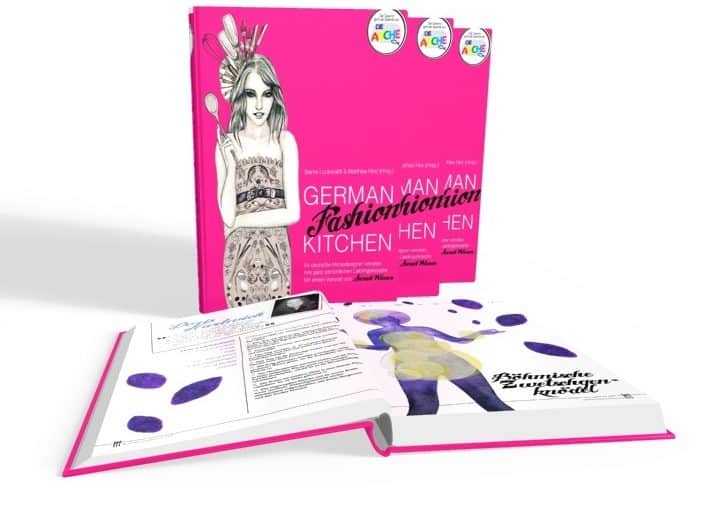
Das Lieblingsrezept von Livia Ximénez Carrillo & Christine Pluess von mongrels in common sowie weitere 54 Gerichte, empfohlen von Deutschlands Mode-Designern, finden Sie im Charity-Kochbuch „German Fashion Kitchen” – mit einem Vorwort von Starköchin Sarah Wiener!

Worauf freuen Sie sich bei der Mercedes-Benz Fashion Week Berlin am meisten?
Ich freue mich, den Besuchern der Bread & Butter unsere Denim-Innovationen für den Herbst und Winter 2012/2013 zu zeigen. Vor allem die „New Radar”-Linie mit tiefer angesetzten Fronttaschen – sehr lässig, ohne die Hose tief tragen zu müssen. Auch die neuen und G-Star-exklusiven „DeepTones”-Färbungen dürften unseren Kunden gefallen, denn damit dunkle Denims dunkel.
Ihr liebstes Stück aus Ihrer Kollektion für den Winter 2012/2013, das absolute Must-have?
Mein persönlicher Liebling ist die „Radar High Waist Skinny”: Die hohe Taille lässt das Bein länger wirken, und bequem ist die Hose auch noch. Mir gefällt auch die sehr moderne Silhouette.
Ihre Kollektion A/W 2012/2013 in einem Satz?
Eine betont feminine Kollektion mit starker Attitüde, ausgefeiltem Schnitt, raffinierten Details und einer hervorragenden „verbrannten” Farb-Palette.
Welches ist Ihr geheimes Talent?
Verriete ich’s, wär’s ja kein Geheimnis mehr … :o)
Welcher Superheld wären Sie gern?
Ein Superheld zu sein reizt mich nicht sonderlich.
Zu welcher Musik joggen Sie am liebsten?
Momentan höre ich die dänische Popsängerin Agnes Obel gern. Ihre Musik wirkt klassisch mit einem feinen Unterton von Melancholie, dazu ist sie künstlerisch ungemein ausgereift – und gleichzeitig von extremer Einfachheit.
Von welchem Film kriegen Sie nie genug?
Ich sehe eigentlich keinen Film mehrmals, egal wie gut er ist. Die einzige Ausnahme ist „Dinner for One” zu Silvester. Das ist ziemlich lustig … jedes Jahr wieder.
Was lesen Sie gerade?
„Brandwashed: Tricks Companies Use to Manipulate Our Minds and Persuade Us to Buy” von Martin Lindstroem.
Ihr Lebensmotto?
Ich kreiere gern schöne Dinge für ein wundervolles Leben.
Was inspiriert Sie?
Meine Kollegen, mein Team. Und Pierre Morisette, seit 22 Jahren G-Stars Head of Design.
Rebekka Bach wurde in Seoul geboren und wuchs in Dänemark auf. Nach ihrem Designstudium arbeitete sie in Amsterdam für die Bestseller Group, wo sie an der Lancierung der Denim-Marke Object Collectors Item beteiligt war. Sie folgte der Marke noch 2005 nach Italien, ehe sie schließlich zu G-Star – und nach Amsterdam zurückkehrte. Als Women Design Manager übersieht sie heute nicht nur das Denim-Design für Frauen sondern die gesamte Damen-Kollektion der Marke.
HÖRTIPP:
Lernen Sie Designer, Fotografen, Künstler und Kreative in spannenden Podcast-Interviews kennen: Nahtlos! Das Lifestyle Podcast
Worauf freuen Sie sich bei der Mercedes-Benz Fashion Week Berlin am meisten?
Auf meine Basler-Show im Hotel de Rome. Und darauf, den Kunden, der Presse und unseren VIPs die neue Kollektion vorstellen zu können. Natürlich auch auf das Shooting der allerneuesten Anzeigen danach, ebenfalls im stilvollen Ambiente des Hotels.
Ihr liebstes Stück aus Ihrer Kollektion für den Winter 2012/2013, das absolute Must-have?
Ein kleines, schwarzes Eutikleid aus Jersey mit goldenem Reißverschluß.
Ihre Kollektion A/W 2012/2013 in einem Satz?
Luxuriös, modern, sexy.
Welches ist Ihr geheimes Talent?
Making women look beautiful.
Welcher Superheld wären Sie gern?
Superman – keiner kann die Kleidung so schnell wechseln wie er.
Zu welcher Musik joggen Sie am liebsten?
Disco.
Von welchem Film kriegen Sie nie genug?
Was lesen Sie gerade?
„Will work for shoes“ by Susan Ashbrook – sie ist eine berühmte Stylistin aus Hollywood, mit ihr habe ich oft gearbeitet.
Ihr erstes Auto war …
… ein Nissan Jeep Pajero.
Ihr Lebensmotto?
Don’t worry, be happy & always look on the bright side of life.
Was langweilt Sie?
Nichts tun.
Was treibt Sie an?
Meine Arbeit, meine Kreativität.
Der gebürtige Schotte Brian Rennie, 48, ist seit März 2011 Creative Director der Basler Fashion GmbH und Mitglied der Geschäftsführung. Nach seinem Studium am Royal College of Art war Rennie rund 20 Jahre für Escada tätig, davon zwölf Jahre als Design Director. Vor seiner Position bei Basler machte Rennie Station bei Gant.
HÖRTIPP:
Lernen Sie Designer, Fotografen, Künstler und Kreative in spannenden Podcast-Interviews kennen: Nahtlos! Das Lifestyle Podcast
Worauf freuen Sie sich bei der Mercedes-Benz Fashion Week Berlin am meisten?
Wenn es vorbei ist!!! Ich freue mich auf die Präsentation meiner Kollektion und darauf, dass ich mich danach neuen Projekten widmen kann.
Ihr liebstes Stück aus Ihrer Kollektion für den Winter 2012/2013, das absolute Must-have?
Es wäre zu früh, um sich festzulegen.
Ihre Kollektion A/W 2012/2013 in einem Satz?
Apokalypse. Der gewaltsame Bruch und die Schönheit, die dadurch entsteht.
Welches ist Ihr geheimes Talent?
Im Allgemeinen lebe ich meine Talente aus.
Welcher Superheld wären Sie gern?
Federico Fellini – seine Genialität und Inszenierungskraft sucht ihresgleichen.
Zu welcher Musik joggen Sie am liebsten?
Jazz oder Klassik.
Von welchem Film kriegen Sie nie genug?
Ganz eindeutig „Tony Takitani” von Jun Ichikawa. Ich sterbe für asiatisches Kino. Dieser Film hat auch unter anderem meine neuste Kollektion inspiriert. Ich krieg von dieser Bildgewalt nie genug.
Was lesen Sie gerade?
Ich lese gerade die Biographie von John Martin und parallel die von Andy Warhol.
Ihr erstes Auto war …
Ich glaube, ein alter dunkelblauer Mercedes. Ich lege keinen großen Wert auf technische Dinge – solange sie sich mich weiterbringen, erfüllen sie ihren Zweck!
Ihr Lebensmotto?
Ich sehe das Leben nur noch als Realsartire.
Was langweilt Sie?
Einseitigkeit. Stillstand. Kurzsichtigkeit.
Was treibt Sie an?
Perfektion. Sie ist die wohl erstrebenswerteste Form von Ästhetik. Und mein Streben nach Perfektion kennt keine wirklichen Grenzen, die ich einzuhalten gar nicht in der Lage wäre.
Der Designer Dawid Tomaszewski studierte am Londoner College of Fashion, an der Berliner Universität der Künste unter Vivienne Westwood sowie Kunstgeschichte an der Academy of Fine Art in Posen (Polen). Nach erfolgreichen Teilnahmen beim Premium Young Designer Award sowie Designer for Tomorrow gründete der Designer Ende 2009 sein „New Couture”-Label Dawid Tomaszewski. Eine Casual-Linie („Studio line”) komplettiert mittlerweile sein Angebot.
HÖRTIPP:
Lernen Sie Designer, Fotografen, Künstler und Kreative in spannenden Podcast-Interviews kennen: Nahtlos! Das Lifestyle Podcast
Worauf freust du dich bei der Mercedes-Benz Fashion Week Berlin am meisten?
Neben den Shows talentierter Jungdesigner wie Hien Le, Augustin Teboul oder Von Bardonitz, natürlich auf unsere Opening Party mit Dandy Diary im Flamingo. Das wird sicher fetzig.
Dein liebstes Stück für den Winter 2012/2013, ein absolutes Must-have?
Ich durfte vorab schon einen Blick auf die neue Kollektion von Malaikaraiss werfen und habe mich total in einen Rock aus plissiertem Leder mit schwarzen Swarovski-Steinen verguckt.
Was ist dein geheimes Talent?
Synchronstimmen zuordnen.
Welche Superheldin wärest du gern?
Tank Girl
Zu welcher Musik joggst du am liebsten?
Ich jogge eigentlich nie. Im Fitnesstudio höre ich gerne Ladytron.
Von welchem Film kriegst du nie genug?
Aktuell gerade „Drive”, auch der Soundtrack ist großartig. Außerdem „Night on Earth”, „Brazil” und „The Royal Tenenbaums”.
Was liest du gerade?
„Wenn du heulen willst, geh raus!“ von Kelly Cutrone.
Dein erstes Auto war …
Ich hatte noch nie ein eigenes Auto.
Dein Lebensmotto?
Habe ich nicht. Das Leben verändert sich doch ständig, wie kann man sich da auf ein immer gültiges Motto festlegen?
Was langweilt dich?
Blinde Trend-Hörigkeit.
Was treibt dich an?
Freude an der Mode, Neugierde und Begeisterungsfähigkeit.
Web-bekannt wurde die gebürtige Darmstädterin Katja Schweitzberger mit ihrem Blog bees and ballons. Seit September 2011 hat sie nun bei Deutschlands erfolgreichstem Modeblog Les Mads den pencil skirt an.
HÖRTIPP:
Lernen Sie Designer, Fotografen, Künstler und Kreative in spannenden Podcast-Interviews kennen: Nahtlos! Das Lifestyle Podcast
Worauf freuen Sie sich bei der Mercedes-Benz Fashion Week Berlin am meisten?
Meine erste eigene Runway-Show – und das Schnitzel im Borchardts auf der „Vogue”-Party.
Das liebste Stück aus Ihrer Kollektion für den Winter 2012/2013, ein absolutes Must-have?
Eine kurze schwarze Abend-Jacke, mit Einsatz aus plissiertem Leder.
Ihre Kollektion A/W 2012/2013 in einem Satz?
Starke, feminine Casual-Styles mit 70’s Flair aus innovativen Materialien.
Welches ist Ihr geheimes Talent?
Man sagt, ich kann sehr gut kochen; am liebsten traditionelle Gerichte wie bei Oma.
Welcher Superheld wären Sie gern?
Wonder Woman.
Zu welcher Musik joggen Sie am liebsten?
Ich jogge nicht. Mein momentaner Musik-Liebling „Dillon“
Von welchem Film kriegen Sie nie genug?
„Star Wars”.
Was lesen Sie gerade?
„Sleeping with the Enemy: Coco Chanel’s Secret War”
Ihr erstes Auto war …
… ein VW Polo.
Ihr Lebensmotto?
Lebe den Tag.
Was langweilt Sie?
Ignorante Menschen.
Was treibt Sie an?
Liebe Menschen, die mich unterstützen – und der Wille, mein Label voranzubringen.
Malaika Raiss, 26, kam nach ihrem Abschluss als staatlich geprüfte Modedesignerin in Mannheim im Sommer 2008 nach Berlin. Zunächst war sie Assistentin im Team von Lala Berlin, danach arbeitete sie freiberuflich für verschiedene Label. Seit 2010 arbeitet sie nun mit ihrem Team an den klaren Silhouetten und den humorvollen Details ihres Labels MALAIKARAISS. Das Credo: Modische all time favorites – gefertigt mit viel Liebe, noch mehr Hingabe und einem breiten Lächeln.
HÖRTIPP:
Lernen Sie Designer, Fotografen, Künstler und Kreative in spannenden Podcast-Interviews kennen: Nahtlos! Das Lifestyle Podcast
Worauf freuen Sie sich bei der Mercedes-Benz Fashion Week Berlin am meisten?
Unsere erste eigene große Show am 19. Januar um 21 Uhr im Karlsson!!!
Ihr liebstes Stück aus Ihrer Kollektion für den Winter 2012/2013, das absolute Must-have?
Ein legerer Wolljerseyoverall in Nadelstreifenoptik.
Ihre Kollektion A/W 2012/2013 in einem Satz?
Après-Ski anno 1966.
Welches ist Ihr geheimes Talent?
Was wäre ein geheimes Talent, wenn es jeder kennen würde?
Welcher Superheld wären Sie gern?
Black Widow – ein Allroundtalent der Superklasse. Sie ist Abenteurerin, Geheimagentin und Ballerina.
Zu welcher Musik joggen Sie am liebsten?
Madonnas Album „Hard Candy”
Von welchem Film kriegen Sie nie genug?
Was lesen Sie gerade?
„Bestellungen beim Universum. Ein Handbuch zur Wunscherfüllung” von Bärbel Mohr.
Ihr erstes Auto war …
Ich fahre Rad.
Ihr Lebensmotto?
Durch Stolpern kommt man weiter. Man darf nur nicht fallen und liegenbleiben.
Was langweilt Sie?
Stillstand.
Was treibt Sie an?
Herausforderungen.
Die zwei jungen Designerinnen Anna Franke und Janine Weber lernten sich während des Studiums in Berlin kennen und entschlossen sich nach zahlreichen beruflichen Zwischenstopps schließlich dazu, mit majaco ein eigenes Label zu gründen. Zeitgeist und Tragbarkeit sind ihre zwei wichtigsten Maximen, ihre Entwürfe sollen den Alltagstest bestehen und sympathisch sein.
HÖRTIPP:
Lernen Sie Designer, Fotografen, Künstler und Kreative in spannenden Podcast-Interviews kennen: Nahtlos! Das Lifestyle Podcast